
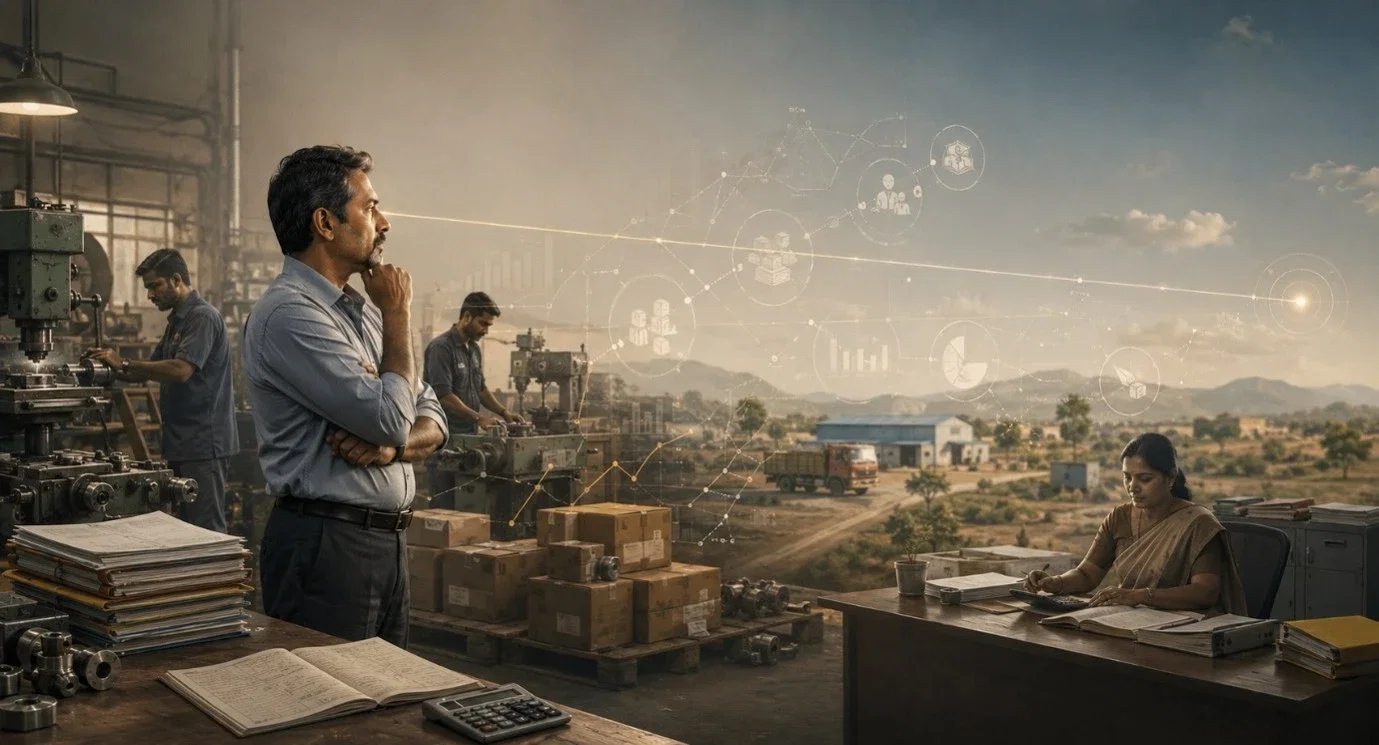
A business and its balance sheet are measured separately — one in turnover, the other in trust — yet they describe one living thing seen twice. So it is with enterprise and enquiry: enquiry is the diagnosis that makes a struggling business legible, and enterprise the daily grind that turns that diagnosis into a going concern. Running a business and understanding why it runs or fails are not two separate acts, but one divided by habit.
Over time, that habit hardened into a wall. The advisor, the auditor, and the academic followed enterprise into ratios, models, and frameworks, while the shop floor and the shop owner encountered it as cash flow, orders, and survival. This was not a divide born of neglect but of scale: the MSME sector in India alone runs into tens of millions of units, each one too small, too local, and too busy surviving to pause and be studied.
As both worlds grew, they came to be known in different languages. The entrepreneur learns the business as one body — supplier, worker, customer, lender, family — before any of it is named a “function.” The consultant or researcher, by contrast, fragments the same body by method: finance, operations, marketing, behavioural science, each demanding its own years of apprenticeship. No stage of an entrepreneur’s journey opens that landscape for them. Most owners meet a fragment of it, late, informally, from a well-meaning friend or a lender’s checklist, and never the whole architecture of why some MSMEs cross into stability and most do not.
This asymmetry matters gravely. The entrepreneur feels the symptom — a stock pile-up, a client who won’t pay on time, a family quarrel bleeding into the books — without knowing which of a dozen possible causes is the real one. Yet the entrepreneur’s vantage, lived daily and at stake personally, is irreplaceable: it tells which questions are worth asking and whether any advice offered has actually reached the business. Still, closeness to one’s own problem rarely turns into diagnosis. Patterns stay anecdotes passed at trade association meetings. Failures are absorbed quietly and repeated by the next owner down the street. Uncertainty travels from one struggling firm to the next without ever becoming evidence anyone can use. What is needed is not the entrepreneur alone, nor the researcher alone, but a discipline that holds both: reading the MSME the way a clinician reads a patient — a body with a history, a set of vital signs, and a prognosis that responds to intervention.
This figure — call it the Gladiator-Archer, fighting to survive and aiming to answer, or the practice that produces the same effect at the level of the firm — is not born of instinct. It is built. The complexity of modern markets has not made rigorous understanding of enterprise unnecessary; it has made it harder to construct without deliberate scaffolding. The questions arise naturally at the till and on the factory floor; the discipline to answer them systematically does not. It requires curricula, mentorship, instrumentation, and institutions purposefully designed to bridge the workshop and the seminar room.
Other domains met an equivalent challenge long ago. Medicine, for instance, took a century to formalise clinical training and clinical research into a single, disciplined pathway, building fellowships, protected time, and dedicated institutions once it recognised that practitioners could not be left to become rigorous by accident. Enterprise development in India has largely skipped that step. Skilling schemes, credit schemes, and cluster programmes have multiplied; a parallel, disciplined pathway that turns a struggling proprietor into someone who understands their own enterprise with the rigour of a diagnostician has not.
India’s case is not that entrepreneurial insight has been forgotten; it is that, for decades, it was crowded out by necessity. A country needing livelihoods at scale had to prioritise formation over understanding — starting units mattered more than studying why they falter. Numbers over enquiry was the correct sequence when survival itself was the emergency. But that old sequence is no longer sufficient, because India is reaching a rare junction of its own: the country’s capacity to observe, measure, and mentor its MSMEs at scale is rising at the very moment the cost of not doing so — informalisation, closures, and stalled family enterprises — is becoming impossible to ignore.
The capacity is visible, and so is the gap. MSME registration, digital footprints through GST and UDYAM, and formal lending data have expanded dramatically over the past decade, giving India more usable signal about its small enterprises than it has ever had. Structured, sustained diagnostic and mentoring pathways for individual enterprises, in contrast, remain vanishingly rare — a workshop here, a scheme there, seldom a continuous relationship that tracks a firm’s vital signs over years the way a treating physician would. What we have built at Poornatha through MyB — triangulating the individual promoter’s profile, the organisation’s profile, and a structured body of knowledge — is one such attempt at that missing architecture; it remains, by design, one seat at a very large table. The question, then, is changing: India is no longer asking only how to start more enterprises; it must ask how the enterprises already standing can become places where their own difficulties are properly understood.
The need is urgent because the next era of enterprise support cannot simply be imported from elsewhere. A formula built for a factory in another country, or even another Indian state, cannot be applied whole to a family-run unit in Tirunelveli or a first-generation trader in a district town; the diagnosis must be tested against local realities — the promoter’s own history and temperament, the nature of local credit and labour, the family’s tolerance for risk, and the system that must actually deliver any help. A working-capital crunch that looks identical on paper can trace to entirely different roots — a demanding customer’s payment cycle in one firm, an unresolved family succession question in another — and only a disciplined, individualised reading distinguishes the two.
The responsibility here reaches beyond India. Many of the constraints that crowd an Indian MSME — thin working capital, informal family governance, fragile customer concentration, limited access to structured mentoring — are shared widely across the developing world, yet remain underserved by both global research and mainstream advisory markets, which chase scale and the visible enterprise, not the millions of small, quiet ones. If India builds the discipline and the institutions for its own Gladiator-Archers, it will not only answer its own questions; it can build the frameworks, the diagnostics, and the mentoring models for much of the global South, where the same enterprises, the same constraints, and the same unanswered questions have waited far too long.
To meet this moment, India needs Gladiator-Archers — and the institutions willing to shape them. Without this discipline, expanding access to credit and skilling will start more enterprises but leave too many of their difficulties unasked, undiagnosed, and unresolved. With it, MSMEs can become not just units that survive, but sites where the causes of survival and failure are actually understood — for their own sake, and for every other economy whose small enterprises the world has too often treated as too small to study.
Why Gladiator-Archer, and not merely the entrepreneur, is the truer name for this figure becomes clear from the condition both halves describe. The entrepreneur is first a Gladiator: not a chosen calling but a daily contest for survival, where the ground is uneven, the opponent often unnamed, and the fight cannot be declined. But survival alone does not build a business; the same figure must also be an Archer, and the bullseye an archer aims at is never fixed — it moves with the season, the customer, the family, the year. Some moments demand the tactical eye: the one defaulting customer, the one wrong hire, must be seen and nothing else allowed to blur that seeing, exactly as an archer narrows the world to a single point before the release. Other moments demand the strategic eye: the promoter must read the market turning around the firm, the next generation waiting to inherit it, the credit cycle changing shape — sensing the whole field the way a warrior must, without ever losing sight of the shot the day itself demands. Context, in both postures, is king; only its scale changes, tactical to strategic and back again, as the moment requires. The Gladiator-Archer we have described is, in the end, only this: one who fights because there is no option to withdraw, and aims because the target, however much it shifts, must still be met.
Bharath K S Founder Chairman & Mentor, Aparajitha Foundation | Poornatha